

Role Clarity: The Succession Thinking Principle That Makes Handover Possible
Drawing on Succession Thinking®, the framework by Bill Withers.
Ask an established business owner to describe their role and the answer comes quickly. They run the business. They make the key decisions. They hold the relationships that matter. They are, in some ways, the business. That answer is true and it is the problem, because it describes everything they do without naming anything they own.
The first principle of Succession Thinking®, the framework developed by Bill Withers through 35 years of building and advising owner-led businesses, is seek role clarity. It sits first in the framework because it is the condition everything else depends on. Before an owner can hand over leadership, before culture can run independently, before systems can carry the business forward, someone has to know precisely what each person owns, and that work starts with the owner themselves.
The five roles most owners carry without naming them
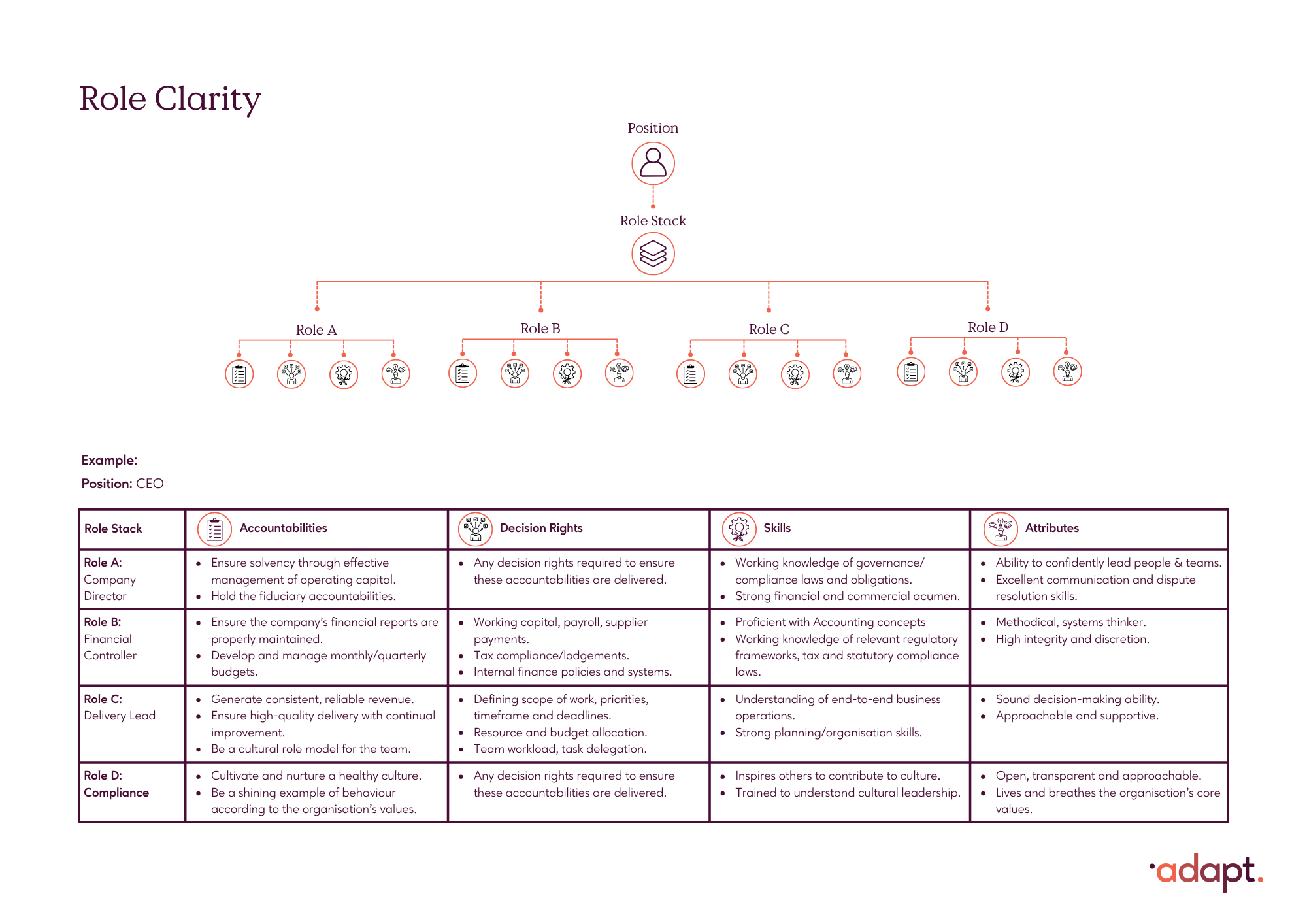
Most established SME owners are simultaneously carrying five distinct roles, usually without ever separating them. Bill Withers names them: the owner, who makes capital and ownership decisions; the director, who carries governance and fiduciary duty; the organisation leader, who holds accountability for the whole company’s strategy and performance; the team leader, who runs a defined team; and the technician, who does the specialist work itself.
In the early years, carrying all five is both necessary and manageable. As the business grows, the stack becomes unsustainable, and invisible. The habits and behaviours the technician and team leader roles demand are fundamentally different from what the owner role demands. When they run simultaneously, the owner role almost always loses. The governance does not get done. The vision does not get documented. Capital decisions get made reactively. The business does not get what it needs from its owner because its owner is too busy being everything else.
The naming of those five roles, simply acknowledging that they are distinct, is the starting point. You cannot do the owner’s vision work until you acknowledge that the owner is a role with its own accountabilities, separate from the role of the person who runs the team or delivers the technical work. As Bill Withers puts it, you need to “park the car” to do the work of the owner, and you can only park it once you know you’re driving it.
What a role actually is
A role, in the Succession Thinking® framework, is defined precisely: a set of accountabilities that can be executed by someone with the required skills and attributes. That definition carries weight. It means a role is not a job title. It is not a list of tasks. It is a set of outcomes someone is responsible for delivering, together with the capability profile that enables someone to deliver those outcomes.
Every position in a business holds a role stack, the complete set of distinct roles that person is responsible for executing. The role stack of a CEO in one business will look nothing like the CEO role stack of a business at a different stage, in a different industry, with a different leadership team around them. The structure is universal. The content is unique to every business.
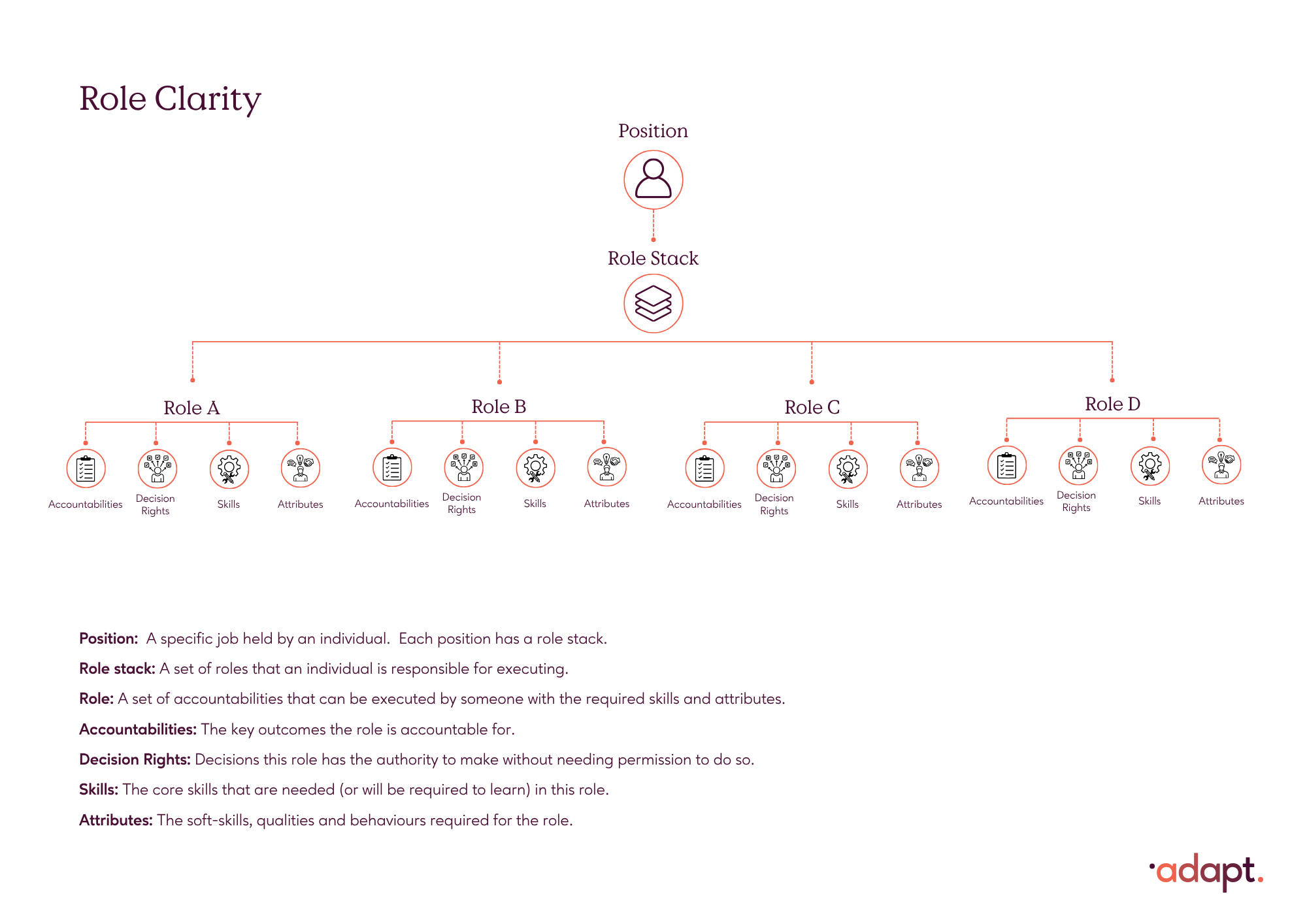
Each role is defined across four dimensions.
Accountabilities are the key outcomes the role is responsible for delivering, not what someone does on a given day, but what the business gets back from this role existing. Accountabilities are what gets measured, and what transfers when the role transfers.
Decision rights are the decisions the role can make without needing permission. This is where most SMEs are imprecise, and the imprecision is expensive. When it is unclear who can make a decision, decisions queue for the person who has always made them, which in an owner-led business is almost always the owner. Explicit decision rights let the business move at its own pace, without the owner in the chain.
Skills are the core competencies the role requires, whether brought to it or developed within it. A defined skills profile makes it possible to hire precisely, assess honestly, and build a clear development path for someone growing into a role.
Attributes are the behavioural qualities the role demands, how someone needs to show up to perform it well, independent of their technical capability. These are what most SME hiring gets wrong, because they were never named before the hire.
What the model looks like in practice
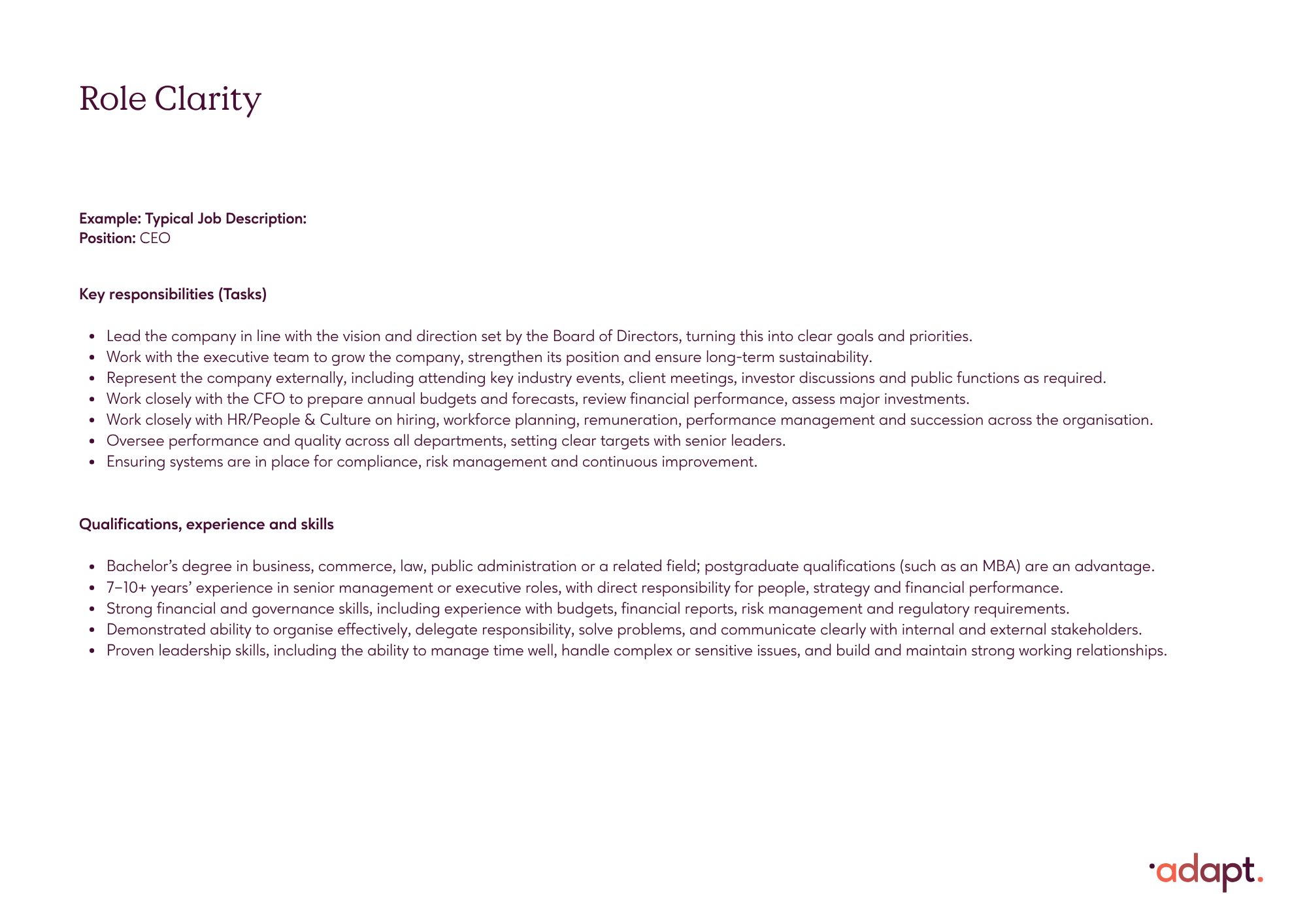
The diagram below illustrates how a single position breaks into a role stack, with each role carrying its own accountabilities, decision rights, skills and attributes. The example uses a CEO position to show the logic. In practice, the number of roles in any position varies, and the content of each role is unique to the business. What matters is the question the model asks, not what the answer should be.
Why role clarity makes handover possible
You cannot hand over what you have not named. That is the practical consequence of this principle. An owner who cannot list the distinct roles they hold cannot sequence their own handover. They can delegate tasks. They can give someone a new title. But the accountability, the outcomes and decision rights that make a role real, stays with the owner until the role is defined precisely enough to transfer.
Handover happens role by role, not position by position. An owner who has separated their organisation leader role from their technician role from their director role can begin the handover sequence. Each role can move when the incoming person is ready to carry it. The accountability transfers with definition attached, and it stays transferred.
Role clarity also changes what happens after a handover. A person who inherits a well-defined role knows what they own, which decisions are theirs, and what success looks like. They are not left to interpret a vague mandate or fill structural gaps with guesswork. That clarity is what makes a leadership team genuinely capable rather than capable but perpetually waiting for permission.
This is why role clarity is Principle 1. Not because it is the most dramatic change, but because every other step in the Succession Thinking® framework (building leadership beyond the owner, embedding culture, documenting the business way) depends on it. The work of building an owner-independent business is a sequence of handovers. Naming the roles is how the sequence begins.
Where to start
The most direct starting point is the honest question the framework poses: how many distinct roles are you currently carrying, and have you named them?
For most established owners, that inventory reveals more than expected, and surfaces the source of much of the friction, the overload, and the dependency that keeps the business from running well in their absence. Once the roles are named and their four dimensions are defined, the path to handing them over becomes visible. The business can be built for independence, role by role, from the inside out.
The owner independence diagnostic shows where your business currently depends on you across leadership, culture, systems and succession. If you want to explore what the design work looks like from there, a confidential owner independence review is the next step.